
The Moment You Notice It
You're in the garage grabbing something out of the trunk, and you feel it: warm air sliding in along the bottom of the door, even though it's been closed all afternoon and the thermostat inside says 74. You mention it. Your spouse says the garage is supposed to be hot, that's just Florida. You say it's the reason the AC kicks on every twenty minutes. Neither of you has proof. Here's how to get some.
How a Leaky Garage Door Actually Raises Your Bill
In most houses on the Treasure Coast, the garage shares at least one wall with conditioned living space, and in plenty of homes it also holds the water heater, the HVAC air handler, or ductwork running overhead. The garage itself isn't cooled, so on a sunny afternoon it can easily run 20 to 30 degrees hotter than the outside air. That heat doesn't stay put. It pushes through the shared wall, through the door leading into the house, and through any gaps around the garage door itself.
A garage door with worn-out seals isn't just letting in light and bugs — it's letting that superheated garage air leak toward the parts of your home your AC is working hardest to cool. If your ductwork or air handler sits in that garage, the effect is even more direct: your system is trying to push cold air through metal that's sitting in a 120-degree box.
Why Seals Fail Faster Here Than in Drier Climates
Weatherstripping and bottom seals are rubber, and rubber doesn't hold up well to what this coast throws at it. Salt air breaks down the material faster than it would inland. UV exposure from long, bright afternoons dries it out and makes it crack. And the constant swing between humid mornings, afternoon downpours, and dry heat causes the seals to shrink, harden, or pull loose from their tracks.
It's not just the rubber. Humidity swings make wood-composite and even steel panels expand and contract slightly over time, which changes how evenly the door sits in its frame. A door that used to close flush can develop small gaps at the corners or along one side without ever being hit or damaged. Add a slightly off-track door or springs that have lost tension — common after a few hurricane seasons of use — and the door may not be seating squarely against the weatherstripping at all, no matter how new that weatherstripping is.
The Test That Settles the Argument
You don't need any special tools for this, just a few minutes after dark.
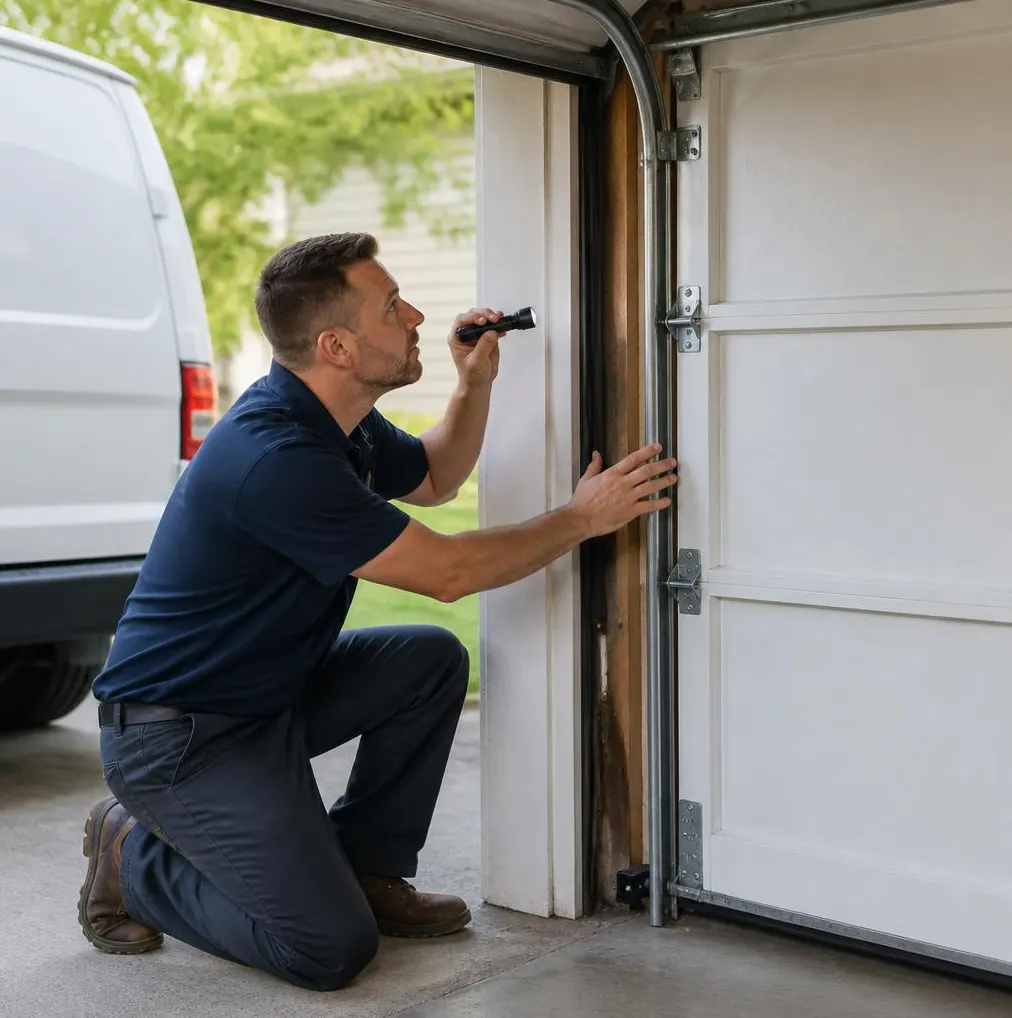
- Flashlight test: Close the garage door, turn off the lights, and have someone shine a flashlight around the outside edges — bottom, sides, and top — while you stand inside. Any light you see coming through is air coming through too.
- Dollar bill test: Close the door on a dollar bill at a few points along the bottom seal. If it slides out easily, the seal isn't gripping.
- Hand test: On a breezy day, run your hand slowly along the inside bottom edge and side seams of the closed door. Moving air means a gap big enough to matter.
- Look at the rubber itself: Cracked, flattened, or stiff weatherstripping that no longer springs back when you press it has already failed, even if it looks intact from a few feet away.
If you find gaps, you have your answer — and now you have proof for the other side of the argument too.
What This Actually Costs You
Beyond the AC running longer than it should, there are a few quieter costs. Your compressor cycles more often, which adds wear to a system that's already working overtime for most of the year here. If rain or humid air is getting pulled in through the same gaps, you're looking at moisture sitting on tracks, hinges, and springs — which means rust, which means a shorter life for the hardware itself. A leaky door isn't just an energy problem; it's usually the first sign of a door that's aging out in more ways than one.
Fixes That Work — and the One That Doesn't
Replacing the bottom astragal seal and the side/top weatherstripping is straightforward and solves the problem if the door itself is hanging straight and square. Kits are sized by door width and are worth measuring carefully before buying.
What doesn't work is caulking or taping over gaps without figuring out why they're there in the first place. If the door isn't closing evenly because it's slightly off its track, because rollers are worn, or because the springs have lost tension and the door isn't seating with even pressure across the bottom, new weatherstripping will fail again within a season. Insulated door panels help with heat transfer through the door itself, but they can't compensate for a door that isn't closing flush.
When to Call Precision Garage Door of Fort Pierce
If the flashlight test shows gaps that come back even after fresh weatherstripping, or the door seems to close unevenly, that's usually an alignment or tension issue rather than a seal issue. We check that during a Garage Door Tune-Up & Maintenance visit — adjusting spring tension, checking rollers and tracks, and making sure the door closes square so new seals actually have something to grip. If the door is visibly riding off its track or dragging on one side, our Off Track Door Repair service gets it back on line and closing the way it's supposed to.
If you're ready to stop guessing and start saving on cooling costs, call Precision Garage Door of Fort Pierce. We serve Fort Pierce, Port St. Lucie, Stuart, Jensen Beach, Vero Beach, Palm City, Tradition, and Hobe Sound, and we're happy to check your seals, your alignment, and everything in between.